

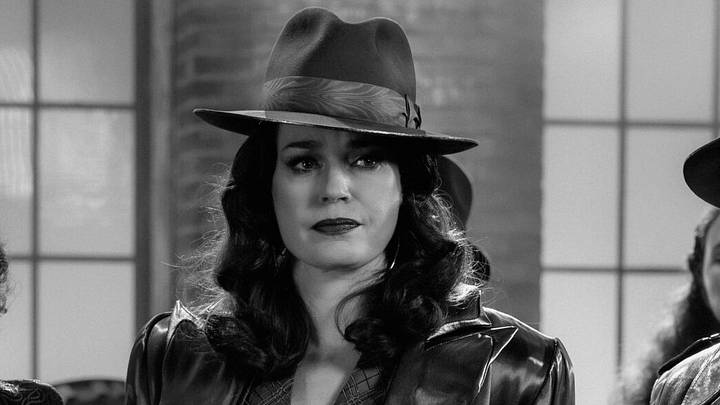
"A Case of Chiaoscuro" is one of Star Trek: Strange New Worlds’ most ambitious stylistic episodes, using a black-and-white film noir world to put Una Chin-Riley (Rebecca Romijn) in a situation with no clean Starfleet answer.
What begins as a covert mission to recover a Federation probe becomes a story of resistance after Una, Dr. M’Benga (Babs Olusanmokun), and Ensign Nyota Uhura (Celia Rose Gooding) are stranded on Klingon-occupied Mat’Aar XII.
The episode’s best move is to force Una to impersonate Nevette, a local collaborator who is secretly the resistance’s most important figure, and who is already dead.
1. Storytelling in shades of gray
Una’s team crosses into Klingon territory to retrieve the wayward Angelo-1 probe, but a D7 battlecruiser blocks their route back after the mission. Forced to hide, Una, M’Benga, and Uhura land on Mat’aar XII, inadvertently triggering the planet’s warning barrier.
The radiation from Mat’aar’s sun explains the black-and-white visual style, but it also gives the planet its classic noir atmosphere: shadows, checkpoints, suspicious allies, and an occupation where people can be arrested for the wrong identification.
The real complication begins when Roman (Andy McQueen) mistakes Una for Nevette. As the owner of a café and a collaborator trusted by the Klingons, Nevette's identity gives Una cover. But Ja’lem (Albert Chung) soon reveals that Nevette was also running the resistance network from behind that public identity.
When Una and M’Benga find Nevette’s body hidden in a refrigeration chamber, the episode makes it clear that Una is not just borrowing someone’s identity; she is being asked to finish a mission that cost someone else her life.
The resistance’s plan is not merely to strike at the Klingons. Nevette had intended to use an electromagnetic pulse to disable the planetary shield system before it could trap Mat’Aar XII’s civilians under permanent occupation.
After infiltrating the munitions facility, Una obtains the detonator and confronts Roman, the man who killed Nevette. She lets him go, correctly anticipating that he will run to report her. When Klingon security finds the detonator on him, it triggers an EMP that shuts down the shield, disables the occupying force’s technology, and even knocks the D7 out of action long enough for civilians to escape.
It is a satisfying ending because Una does not become the resistance’s permanent leader. She hands Nevette’s role to Ja’lem and leaves the future of Mat’Aar XII in the hands of its own people. That decision keeps the story from falling into a familiar “Starfleet saves the planet” ending and gives the resistance real agency.
 Add us as a preferred source on Google