

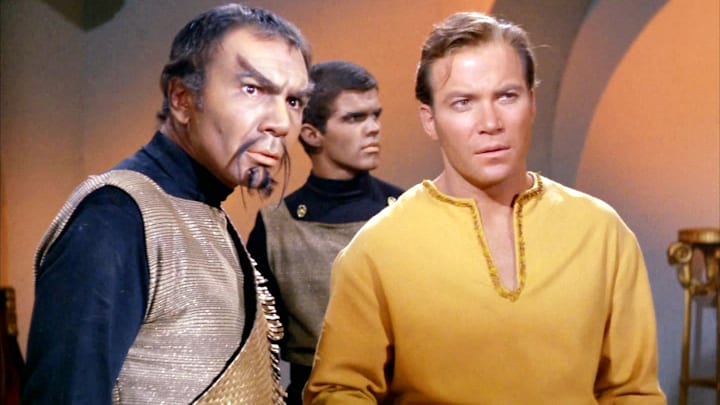
Check out how Star Trek's first Klingon episode makes an excellent Jaws-like case for low-budget storytelling today. How? This particular episode's presentation back in 1967, not to be confused with the remastered Computer-Generated Imagery version, relied very little on visual effects.
In the TOS season 1 episode “Errand of Mercy,” Captain Kirk (William Shatner) and Mr. Spock (Leonard Nimoy) sit in a dungeon on a Klingon-occupied alien world, awaiting execution. Behind a locked door, multiple Klingon guards are patrolling the exit, ready to pounce if they escape.
All hope seems lost, but then, somehow, the door opens to reveal a single man, Ayelborne (John Abbott), offering them the chance to leave. The guards have mysteriously vanished. Minutes later, the Klingons, alive and well, report to their commanding officer, Kor (John Colicos), that the prisoners have somehow vanished from their cell, despite them being under guard the whole time.
How? By what alchemy could Kirk and Spock make their escape through a throng of Klingons watching them like hawks without either party seeing the other?
Ayelborne is later revealed to be of a race of highly evolved, seemingly omnipotent inhabitants of the planet Organia. Composed of pure energy, they were masquerading as humanoids to humor Kirk and the Klingons. Incapable of death by ordinary means, they were simply trying to prevent any of their mortal visitors from being killed.
But that still does not quite explain how they were able to spirit away Kirk and Spock. In fact, the episode itself never explains. It simply expects the audience to make up their own explanation with no visual effects required.
With very few exceptions, which includes the Klingon vessel trading shots with the USS Enterprise in space, Kirk and Spock using their hand phasers on the planet, and Ayelborne and his brethren fading into balls of light at the end, there aren't any costly visual effects in the episode.
Now imagine if that same episode were made in 2025. Kirk and Spock sit in a dungeon awaiting execution. Outside, Ayelborne enters and hypnotizes the Klingons with his mind. Maybe he opens up a pocket dimension or bends the room a la Doctor Strange so that he and the prisoners can slip away unnoticed. Imagine the special effects spectacle that this premise could have allowed for. And yet, this TOS episode gets away scot-free without it.
Modern Trek, for better or worse, has the budget and CGI arsenal to show, not tell, what is going on. And while this is a time-tested rule of screenwriting, it can leave the audience feeling spoon-fed. Part of the fun of storytelling, particularly sci-fi, is that it calls upon the audience to use their head. (Continued...)
 Add us as a preferred source on Google