

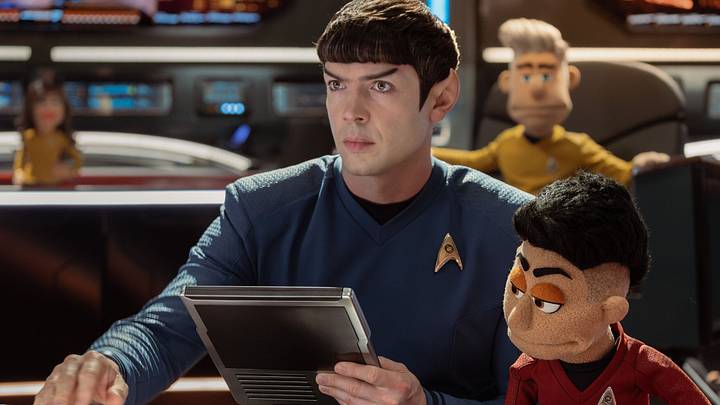
Star Trek: Strange New Worlds season 4's “Level-Five Transporter Accident” begins with Mr. Spock (Ethan Peck) having a terrible week and somehow makes it worse by turning the Enterprise crew into puppets.
Scotty’s attempt to test a long-range transporter with the unsettling puppet Little Ricky triggers an accident that apparently transforms everyone aboard the USS Enterprise, including the ship's guest T’Pring, into felt versions of themselves.
But the episode’s final reveal is that the puppet crisis is a dream Spock, who is the only one not to be transformed into a "Muppet," experiences while unconscious after the actual transporter accident.
That twist makes the episode more than a bold visual experiment. The absurd puppet storyline becomes an anxious Spock fantasy, built out of everything he is struggling to control: his breakup with La’an, unresolved trauma from the USS Griffin, his fear of disappointing T’Pring, and the pressure of being responsible for everyone around him.
1. Acting: Spock’s felt nightmare
Ethan Peck carries the episode by making Spock’s escalating panic feel believable even when he is surrounded by puppets. Before the transporter mishap, La’an ends their relationship after admitting that dancing with Spock has not helped her process what happened on the Griffin. Spock apologizes for failing to be there for her, but she makes clear that neither of them is in a place to continue the relationship.
That breakup leaves Spock more isolated before his planned visit from his former flame, T’Pring. He tells her he wants time on Vulcan to focus on logic, but she recognizes that he is trying to escape the chaos of serving aboard the Enterprise. T’Pring agrees to visit, but only if he can promise there will be no “hijinks,” a promise the episode immediately makes impossible to keep.
Once Spock believes the crew has become puppets, he is bombarded with emergencies that he cannot solve at once. T’Pring’s puppet counterpart has to slap him out of a panic attack and remind him that he cannot help everyone simultaneously. The joke works because it exposes Spock’s core fear: if he cannot maintain control, he may fail the people who trust him.
 Add us as a preferred source on Google