

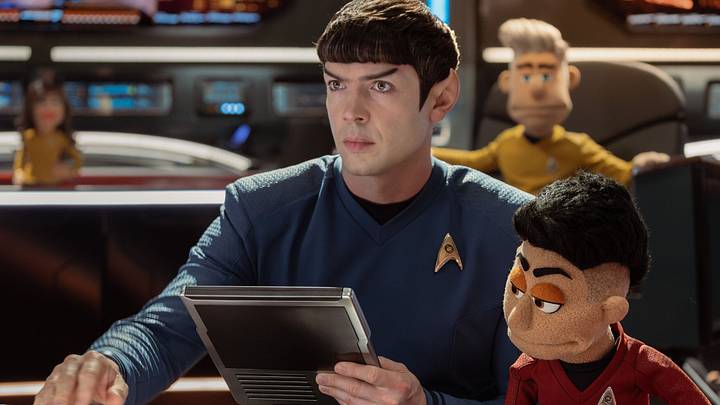
2. Storytelling: The crew goes full puppet
The puppet premise succeeds in "Level-Five Transporter Accident" because the cast and production team commit to the script. Pike’s tiny puppet double is still determined to give captain’s speeches, even after being thrown out an airlock, and Pelia survives being cut in half.
Scotty’s Little Ricky puppet becomes a source of both comic terror and eventual inspiration. The episode never pretends these are normal stakes, but it treats the crew’s reactions seriously enough that the comedy has shape.
The Orion boarding plot gives the puppets a reason to become active participants rather than simply a visual gag. Spock vents the bridge’s oxygen to knock the Orions unconscious, then holds his breath while the puppet crew drags him to safety.
The solution is ridiculous, but it also uses the rules of the dream effectively: the puppets do not need oxygen, so Spock’s strangest problem becomes his advantage.
The climax is especially fun because it lets Spock stop trying to impose logic on an illogical world. After T’Pring helps him regain control by grounding him in logic, Spock is able to face the crisis without trying to solve every problem at once.
The puppet crew’s brief, joyful moment floating outside the Enterprise reinforces the point: not everything strange or chaotic needs to be treated as a threat. When Spock wakes, the real T’Pring is beside him, and the kiss he thought he shared with her puppet turns out to have existed only in his dream.
 Add us as a preferred source on Google