

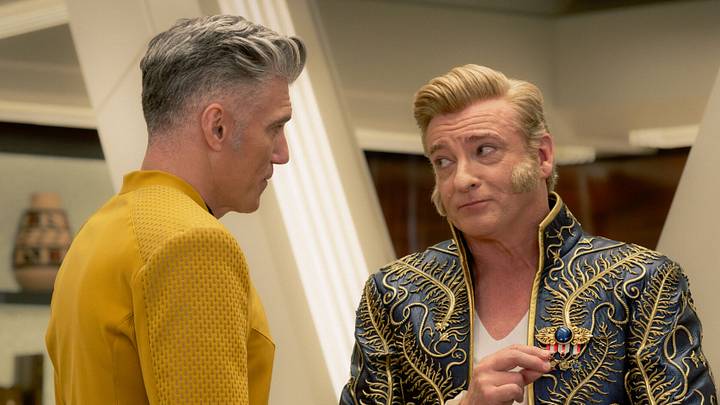
Star Trek: Strange New Worlds season 4's “Like Chronitons Through the Hourglass” turns soap-opera silliness into a surprisingly moving Captain Christopher Pike (Anson Mount) story.
Major spoilers follow, including Trelane’s (Rhys Darby) return, the USS Enterprise crew’s soap-opera reality, Ensign Uhura’s (Celia Rose Gooding) apparent connection to Pike, and the episode’s resolution of Pike’s grief over Batel and Juliet (Anna Mirodin).
“Like Chronitons Through the Hourglass” initially looks like Strange New Worlds taking another gleeful detour into genre pastiche. Beneath the melodrama, however, the episode delivers a surprisingly sincere story about grief, memory, and the future Pike believes he has already lost.
1. Acting: Anson Mount anchors the absurdity
Anson Mount is the reason the premise works. Pike serves as the audience’s entry point into the episode’s increasingly bizarre version of the Enterprise, and Mount gives the captain exactly the right combination of bafflement, patience, and mounting emotional exhaustion.
Mount never plays the material as though it is beneath him, even when he is navigating declarations of secret parentage, dubious diagnoses, and the episode’s deliberately overripe dramatic turns. That grounded performance becomes especially important once the story reveals what Trelane’s fantasy is really exposing.
Pike’s confusion is not merely a plot device; it becomes a way to uncover grief he has not allowed himself to name. Mount conveys the difference between a captain trying to solve an impossible crisis and a man realizing that an imagined life can still leave behind real loss.
Celia Rose Gooding also brings surprising tenderness to Uhura’s belief that Pike is her biological father. The storyline is knowingly melodramatic, but Gooding plays Uhura’s need for connection with enough openness that it reaches beyond the joke.
Uhura's apparent discovery gives Pike a path back to Juliet, the daughter he shared with Batel in the alternate life he experienced in the Strange New Worlds season 3 finale, “New Life and New Civilizations.”
 Add us as a preferred source on Google